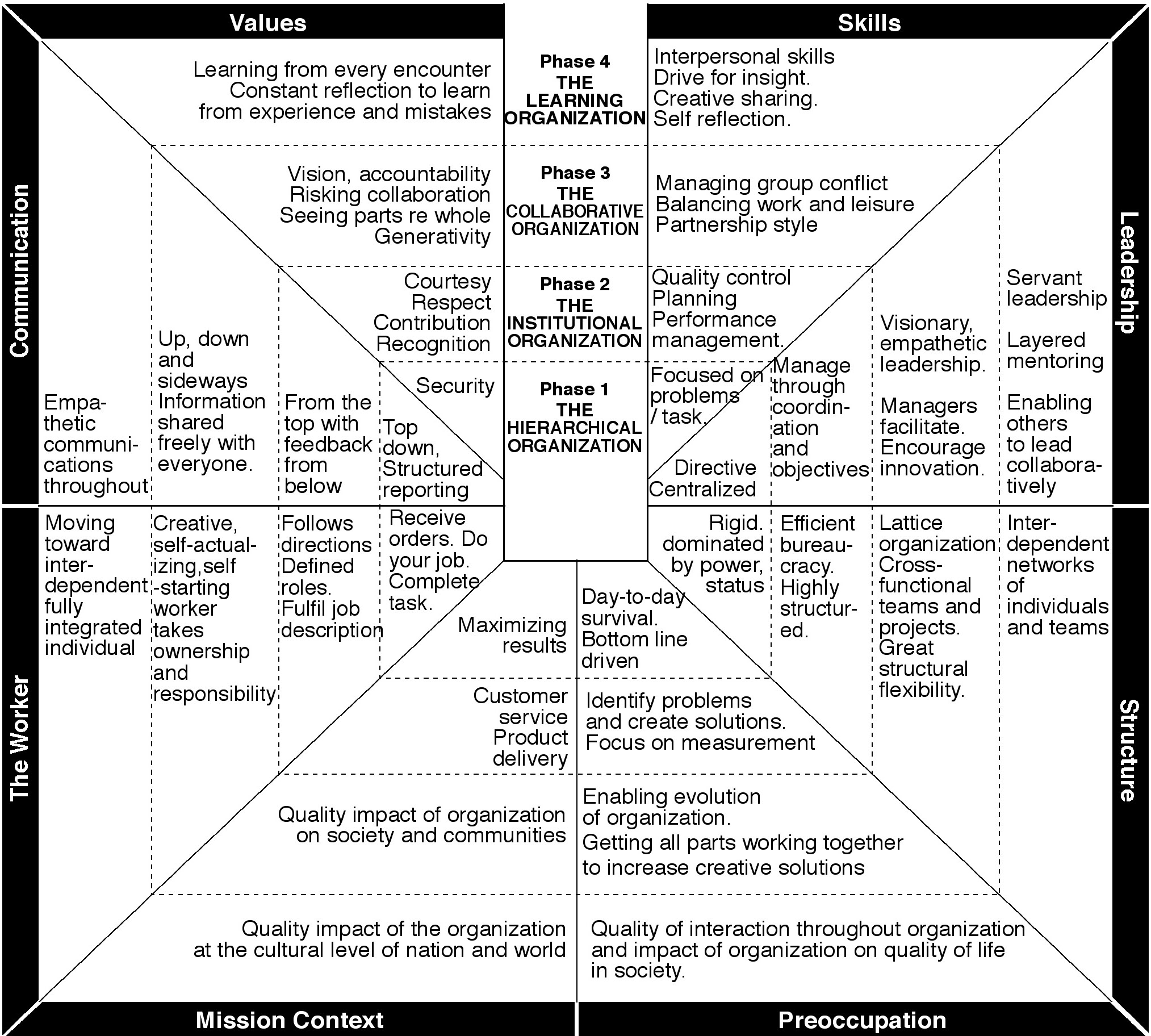
This Map is copyrighted: Copyright Canadian Institute of Cultural Affairs, 1998
Usually the best way to use the Organizational Journey Map is to work with a group in the same room that represents all the levels of the organization, or to start with the lowest level of the hierarchy. This builds a strong understanding of the consensus from the bottom up.
Individuals look at an individual copy of the map and analyze the organization; putting one mark in one of 4 levels in each of the 8 areas for what they see in the organization now, and another mark in a level in each area for how they would like it to be. Then each individual anonymously puts their marks on a shared copy of the map using different colours of dots for now and the future. The exercise ends with a focused conversation on the resulting group map, both what it is like now and another focused conversation on what people want to see. This can provide some deep insights about the organization and provide information for strategy toward a desired future.
You can find more detail on the process from ICA Associates, Inc. https://ica-associates.ca/courses/organizational-transformation/
Starting at the Top of the Organization
One client, struggling with a need for change but little consensus on what change was needed, requested that I start with the executive team. So I facilitated the Organizational Journey Map process with them first. They then wanted to know what others in the organization thought. I did the same exercise with each of the next lower levels of hierarchy one at a time, without sharing the earlier results with any of them.
At the end, I shared with the whole organization what each group had done and they compared them. There was great consensus on what they wanted the organization to be like. This surprised everyone. It led to some major changes in their culture.
Bringing Together Board and Staff
A non-profit client identified some large gaps between their volunteer board and their staff. They did two iterations of the exercise separately with the Organizational Journey Map, one with the board and one with the staff. Then they made copies on transparencies and laid one over the top of the other. The conversations focused on the similarities and differences between the two different groups, and created common understanding on where they were in alignment as well as where they had different perspectives and needed to work together to bring the whole organization into alignment.
A New Board of a Professional Organization
A new board had just been elected of a global professional organization, and were having their first meeting. It was clear that different members had very different opinions about the organization. They decided to use the Organizational Journey Map to understand each other and determine a focus for the development of the organization in the next year.
They discovered that some people wanted the organization to be a fairly traditional institutional organization – most of their dots about the future they wanted were on the second “ring” or level all the way around the map. One person discovered that her yearning for the organization to be way out on the fourth level was very different from the rest of the board. In the conversation on the results, the group realized that they needed to strengthen the structure of the organization at the lower levels in several areas in order to move the organization to the next level. For example, the organization had not mastered “efficient bureaucracy” in the structural area, and therefore trying to work as “interdependent networks of individual networks and teams” was not successful because there was no structure for accountability and therefore led to cross purposes and chaos. The conversation gave the board a solid starting focus for its work together over the next year.


 Jofacilitator
Thank you Jo, this is an excellent article. I am so glad ICA Taiwan was able to support your work on this with our own work from Asia when you created it.
LikeLike