I have recently read reflections by several facilitators on group norms, facilitator neutrality, and “facilitation as manipulation”. I think that this is an important topic, especially in these times.
Thirty-two years ago a group of people (I was a part of it) began the International Association of Facilitators to separate the role of a group meeting leader (a consultant or content provider) who has knowledge or wisdom to present to a group, and the role of a group meeting leader (a facilitator) who has questions and process to help a group discover and create its own knowledge and wisdom. The role of a meeting leader who led with questions and process was barely known in the western world, and certainly not separated clearly. So it was necessary to bring attention and professionalism to the role.
These two roles are on opposite ends of a continuum, and there are roles that contain elements of both, such as a facilitative trainer who shares content but guides the group to discover how it relates to them. However, it is still a challenge for a group leader to understand that being in front of the room doesn’t mean that you have to know and tell people something, and for the group to understand that it is safe to say what they know.
My experience is that when you ask people for their wisdom, and you really listen, they think YOU are wise. And of course when you ask people for their wisdom, and you really listen, you gain more wisdom and get more wise!
The following describes how I begin meetings that I facilitate, to rehearse for my self and make clear to the group that my role is that of a facilitator.
Edited from original post on this blog from February 23, 2015
In the 1990’s, I had a client gig that I knew was going to be a challenging one. Their director had spent 3 years strategically building consensus that they should have a consensus-building workshop! So I decided that I needed to think through some ground rules to start with. Now I have always hated ground rules. They generally come to me as “thou shalt not”s, all negative energy about what you shouldn’t do. Very de-energizing.
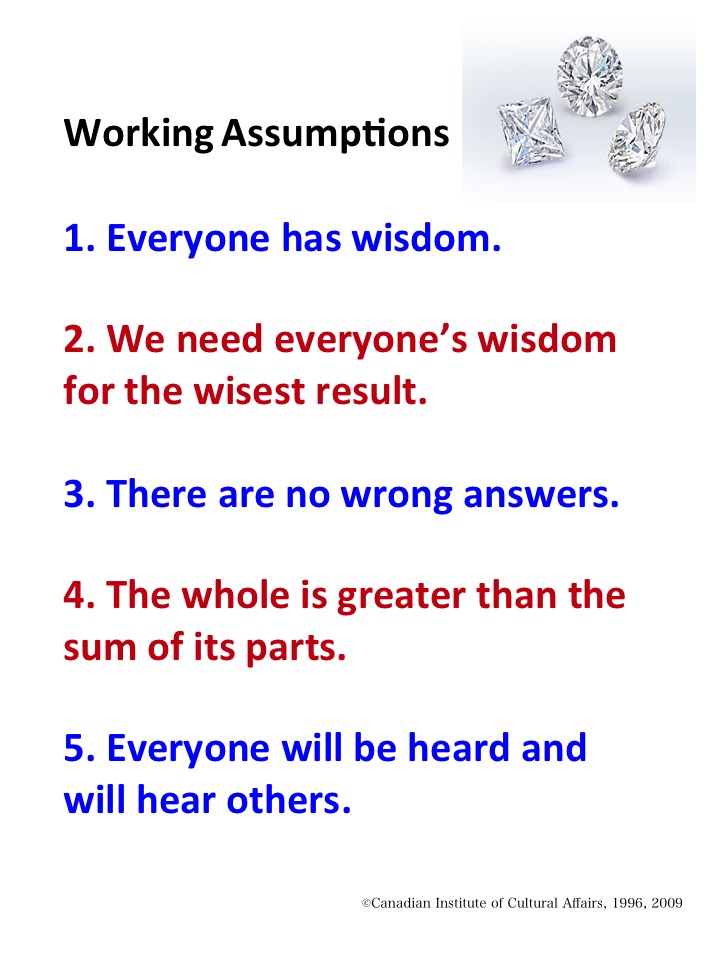
So I created something that at first I called “Ground Rules”. And then I realized that they were not rules at all — they were presuppositions — assumptions that I was making and expected the group to make in order to work together productively. But who wants a 5-syllable word at the top of a flipchart to start the day? So I named them “Working Assumptions”. I have used them ever since with most groups. I write a cryptic form of them on a flipchart (like the image above or the bold type below) and talk through a description of them with the group (in parentheses below).
Working Assumptions
- Everyone has wisdom. (This doesn’t mean everything that everyone says is wise. It means that behind what they say is wisdom, and we will listen for it.)
- We need everyone’s wisdom for the wisest result. (In the same way that a diamond is more valuable when it is cut with more facets, what we come up with will be more valuable when we have illuminated more facets of what we are working with — we all come from different perspectives — some are near each other, some opposing sides, others in a totally different plane from the others, like the facets of a diamond.)
- There are no wrong answers. (This doesn’t mean we agree with everything — I have never been in a room where everyone agreed — even if I’m the only one in the room! Also, see number 1 — behind what may seem on the surface as a wrong answer — and I have heard some that were positively evil on the surface — there is wisdom, and that is what we will listen for. The corollary, of course, is that there are no right answers, only the best we can come up with given our limitations.)
- The whole is greater than the sum of its parts. (A cliche, yes, but it points to consensus as creating a larger answer that is not identical to any one view, but includes the wisdom of many. I think of compromise as smaller than the sum of its parts, consensus as larger. Like a puzzle picture, which is the sum of the puzzle pieces and their relationships. All puzzle pieces are included, or there is a hole. I learned recently that Aristotle came up with this phrase.)
- Everyone will hear others and be heard. (This doesn’t mean that everyone has to talk all the time — then nobody would be heard. It means listening to others as well as making sure your wisdom is on the table.)
I’ve recently concluded that Aretha Franklin would probably summarize the whole list with “R.E.S.P.E.C.T.”
I have never had a group reject these working assumptions altogether. Someone in the very first group, however, did differ with the 3rd one. As soon as I said “There are no wrong answers”, a lady at the back of the room pounded on the table and shouted “There are too wrong answers!” And I thought really, really fast and replied, “And that’s not a wrong answer either!” Everybody laughed. “There are sometimes wrong answers on the surface, but it is the wisdom under them that we are listening for.” The group had a great retreat and listened to each other for maybe the first time in their history.
For number 4, “The whole is greater than the sum of its parts,” I have had various people try to make this more clear. Tim, one of my Cree trainees once said, “You know, it’s like a band. Each instrument — the guitar, the bass, the drums — makes a good sound on its own. But when you put them together, the music they create is greater than any one of them could come up with on their own.” I’ve used his analogy ever since and get lots of nods of understanding.
In order to carry these out, I “hang my opinions on the doorknob” to detach myself from them, so that I am open to hearing the group. If something comes up where I have an opinion or some knowledge that might be useful to the group, I move to another part of the room, tell the group I am taking my “facilitator hat” off for a bit, and make my suggestion. Then I put my “facilitator hat” back on, and move back to the facilitator’s place in the room and ask “Where do we go from here?”


 Jofacilitator
Thank you, Jo. im min-kyu in korea. Thank you for sharing your experience. I have a question. I’m curious about how to distinguish between the “working assumptions” and the ground rules. I’d also like to know if you use the “working assumptions” as a ground rule.
LikeLike
Hi, Min-kyu
The “working assumptions” are the beliefs and assumptions that support “rules”. I find that rules are usually “don’t do this” or “always do this”, which limit participation. So I don’t use ground rules at all.
The “working assumptions” are presuppositions, the things I believe about participation that allow people to speak what they are thinking, in order that we allow wisdom to emerge from the group.
I do put the working assumptions up on the wall and explain them at the beginning of every meeting I facilitate, instead of making ground rules. If people do not have these beliefs, perhaps I should not be facilitating them.
I hope this helps.
Jo
LikeLike