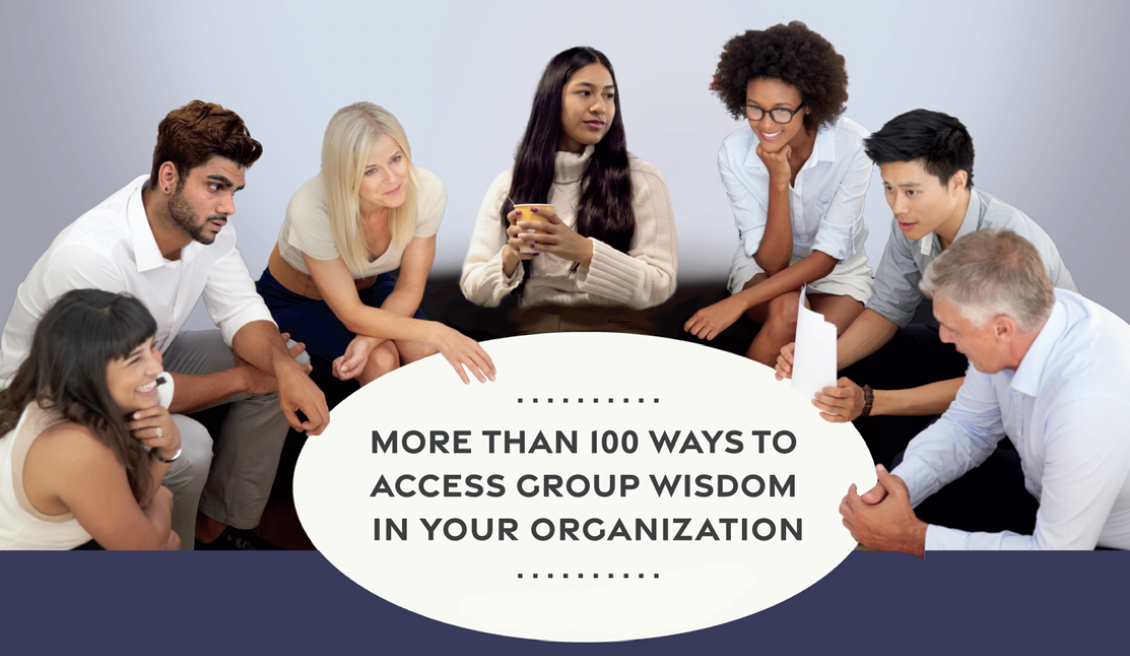
(Photo from the front cover of The Art of Focused Conversation, Second Edition)
This week in February 2026 marked significant religious events in several different traditions. Lunar New Year, the beginning of Ramadan, and Ash Wednesday all happened within 2 days. And within a month, there will be Purim and Nowruz, followed closely by Easter. This led me to a reflection on facilitating diversity.
I grew up in a community where the ethnic differences (and accompanying ancient prejudices) were between the Swedes, the Danes, and the Norwegians, all immigrants or first-generation Americans. It wasn’t until I was grown that I knew people of many backgrounds. Then our family was assigned for 10 years to work doing participatory development in 5 cultures on different continents. We listened to the wisdom of ordinary people from each of the cultures as we facilitated participatory planning and worked shoulder to shoulder with community members in planning and carrying out appropriate development led by them. Then since we moved to Canada, I have had the privilege of working with many different cultural groups and indigenous communities across the nation. In all of these settings, my primary role has been that of group process facilitator, one who asks questions and listens, and learning what it means to do this across differences.
One of the things I have learned is that we are all human beings. None of us, and no one culture, has all the answers, but we all have insights into what it means to be human. We all have insights into what we need to live fulfilled lives.
Someone asked me the other day what we can do these days to build the economic and political structures that we human beings need in this world. My answers to this, not complete answers but starting ones, were that we can first be kind, generous, respectful, and supportive to people in our local community, wherever and whoever they are. That is a foundation. The second is that facilitating groups to listen to each others’ wisdom and to come up with common solutions is a doorway to creating human solutions to profound underlying challenges.
Years ago, I was facilitating a workshop at a conference of multi-cultural organizations in Ontario, to demonstrate some practical tools of facilitation. I had made a point of sharing my “working assumptions” for facilitating groups, which include “Everyone has wisdom” and “We need everyone’s wisdom for the wisest result”. About 20 adults, representing a good cross-section of the world, were actively participating in envisioning what they wanted our multicultural society to look like, brainstorming and sharing their ideas on cards on the wall. My youngest son, then about 7 years old, had accompanied me as it was a Saturday and I hadn’t been able to find child care. He was quietly playing with his Legos in the back corner. Suddenly, one of the participants said, pointing at my son, “What does he think? After all, it’s the next generation who will benefit and continue this!”
I called out, “Tim, what do you want our multicultural society to look like in 5 years?” He thought for a moment, then said, “Can I have three colours of markers?” I said, “Sure”and handed them to him. He took a card and drew 3 stick figures of different colours dancing together.
The card went up on the wall and clustered with all the cards that said that we would be working and playing together in our multicultural society.
We were all astounded that a child’s spontaneous non-verbal contribution could add richness to the product of the adults, although in retrospect, we shouldn’t have been surprised.
We are the ones who can shape the future. And group process facilitation is a profession that has matured in time to help us do that with the wisdom of all.
What do you want to see in our world in 10 years? What can you and we do to help bring that about?
(If you are interested in group facilitation tools that have a deep theoretical base and are grounded in years of real-life experience with groups all over the planet, search for ToP facilitation, or the Institute of Cultural Affairs (ICA) in your area. In Canada, it is ICA Associates, Inc., http://ica-associates.ca , a company related to the not-for-profit ICA Canada (The Canadian Institute of Cultural Affairs) http://icacan.org .)


 Jofacilitator