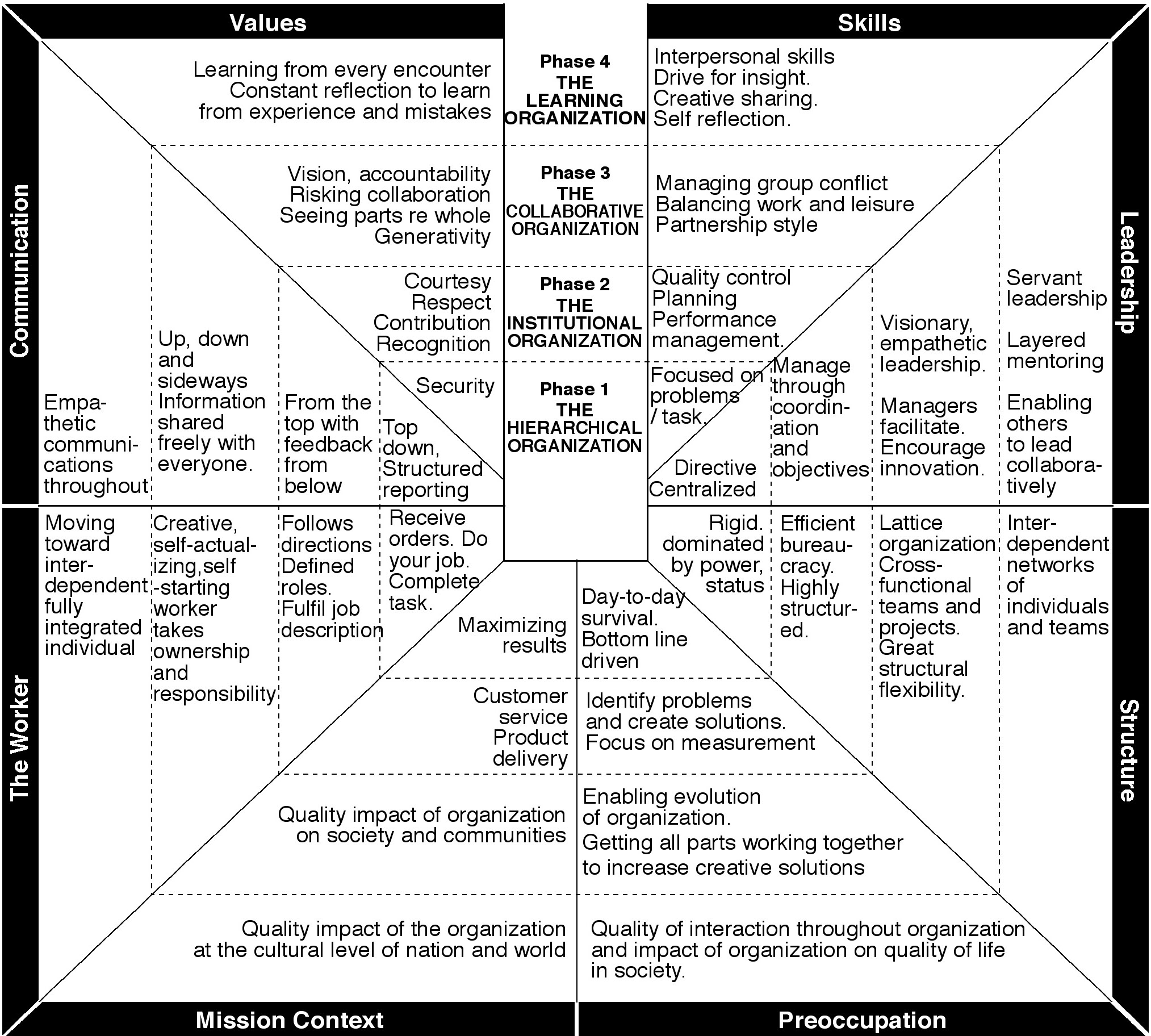
Another Story of the Use of the Organizational Journey Map: (see the original post for the map)
The chief of a police force in a small city was eager to get participation of all officers in decision-making. He had scheduled participatory meetings across the force. His “command staff”, who were committed to the traditional hierarchy of a police force, were commanding those who reported to them not to show up at the participatory meetings.
So the chief asked for facilitation of a meeting of himself and the command staff to examine the issue and bring the discussion out in the open.
So we did an Organizational Journey Map exercise with the command staff – about a dozen people, including the chief. Each officer marked each of the 8 sections on his own copy of the map where he thought the organization was and where he wanted it to be in the future. Then they talked in pairs, not to change each others’ answers, but to clarify their understanding of what was described on the map, and check to make sure they had a shared understanding. Then they all went to the wall map and anonymously added a dot in each of the 8 sectors to show where they thought the organization was. The focused conversation on this map brought some clarity on where the organization was. No surprises here: there was a lot of consensus that they were at Level 1 (Hierarchical) or 2 (Institutional) in most of the sectors, typical of most police forces.
Then they all anonymously added another colour of dot where they wanted the organization to be.
When they looked at this pattern, they were really surprised by the number of dots that showed up on Level 3, the Collaborative Organization. For example, there were more dots than they expected in the Skills sector that they wanted “managing group conflict” and in the Mission Context sector, they wanted “Quality impact of the organization on society and communities”. With the focused conversation, they noted this pattern and realized that as a group they wanted a collaborative organization more than they had realized. The irony in this was that immediately the command staff started to command those who reported to them (Level 1 behaviour) to attend the participatory meetings (Level 3 behaviour), but that was a first step in positive change for the organization.
This Map is copyrighted: Copyright Canadian Institute of Cultural Affairs, 1998
Usually the best way to use the Organizational Journey Map is to work with a group in the same room that represents all the levels of the organization, or to start with the lowest level of the hierarchy. This builds a strong understanding of the consensus from the bottom up.
Individuals look at an individual copy of the map and analyze the organization; putting one mark in one of 4 levels in each of the 8 areas for what they see in the organization now, and another mark in a level in each area for how they would like it to be. Then each individual anonymously puts their marks on a shared copy of the map using different colours of dots for now and the future. The exercise ends with a focused conversation on the resulting group map, both what it is like now and another focused conversation on what people want to see. This can provide some deep insights about the organization and provide information for strategy toward a desired future.
One client, struggling with a need for change but little consensus on what change was needed, requested that I start with the executive team. So I facilitated the Organizational Journey Map process with them first. They then wanted to know what others in the organization thought. I did the same exercise with each of the next lower levels of hierarchy one at a time, without sharing the earlier results with any of them.
At the end, I shared with the whole organization what each group had done and they compared them. There was great consensus on what they wanted the organization to be like. This surprised everyone. It led to some major changes in their culture.
Bringing Together Board and Staff
A non-profit client identified some large gaps between their volunteer board and their staff. They did two iterations of the exercise separately with the Organizational Journey Map, one with the board and one with the staff. Then they made copies on transparencies and laid one over the top of the other. The conversations focused on the similarities and differences between the two different groups, and created common understanding on where they were in alignment as well as where they had different perspectives and needed to work together to bring the whole organization into alignment.
A New Board of a Professional Organization
A new board had just been elected of a global professional organization, and were having their first meeting. It was clear that different members had very different opinions about the organization. They decided to use the Organizational Journey Map to understand each other and determine a focus for the development of the organization in the next year.
They discovered that some people wanted the organization to be a fairly traditional institutional organization – most of their dots about the future they wanted were on the second “ring” or level all the way around the map. One person discovered that her yearning for the organization to be way out on the fourth level was very different from the rest of the board. In the conversation on the results, the group realized that they needed to strengthen the structure of the organization at the lower levels in several areas in order to move the organization to the next level. For example, the organization had not mastered “efficient bureaucracy” in the structural area, and therefore trying to work as “interdependent networks of individual networks and teams” was not successful because there was no structure for accountability and therefore led to cross purposes and chaos. The conversation gave the board a solid starting focus for its work together over the next year.
Most people remember the acronym SWOT for Strengths, Weaknesses, Opportunities, Threats.
One time I had a client ask to do a SWOT before they renewed their strategic plan. It was a difficult time right after a provincial election that was creating chaos in their funding.
They first did a brainstorm of their Strengths and Weaknesses in their own teams.
I then had a day to facilitate workshops on their Opportunities and Threats. I decided to do it the other way around, to focus on the negative of threats first, and then challenge them to think of opportunities. The threats were an easy brainstorm, but it was hard to keep them moving. Clustering by underlying threats was a challenge, to come up with the contradictions language for naming them that was beyond blame and despair. I left the workshop results on the wall but moved them to the side.
After a break, we came back to articulate the Opportunities. I asked the question “What are opportunities at this current time to do things in a new way?” The brainstorm took a long time, but it started gaining momentum in the small groups. Then we clustered the opportunities, and the naming came up with some really big and creative opportunities.
The mood of the group shifted, and when we did the strategic plan renewal after a week or so, it was filled with creative new directions that made a huge difference in the organization’s impact.
I now try to use the acronym as SWTO, although it is more difficult to say as a word!
I was contacted by a person working for a small non-profit who knew something of ToP methods. She said they needed a strategic plan, but they only had a half-day available to do it. On the face of it, this is an impossible request.
So I started asking questions about what had brought them to this point. Her answers revealed that there were two of them, and that they were often stepping on each other’s role and plans, which created paralyzing discord and was sapping their ability to serve their clients.
They did not need a whole strategic plan. What they really needed was a way to clarify their roles, and concrete action plans for each to carry out their roles.
This meant that we could do a conversation on their roles, starting with each listing what they understood their responsibilities to be, followed by a simple Task Force Action Plan by each of them about their next steps. Since the Action Planning format embodies vision, obstacles, strategies, and actions in its process, the whole process took a half-day and satisfied their need.
This emphasizes the need to do a significant consultation with a prospective client before committing to work with them, in order to understand what their real needs are.
This series of posts will be stories from my facilitation career, highlighting lessons I learned from working with clients. I intend for these to be helpful for those I am mentoring, but in general to all facilitators. Perhaps it will mean that you don’t have to learn the same lessons I had to — that you can build on these and build on these learnings. Please feel free to add your stories to the comments!
The following post is the first story in the series….
One of the things I have heard the most in the last few months is a yearning to understand how different people can think so differently about what is going on in the world. Others have said that making meaningful connections with others is really important for mental health.
Since my vocation is about building bridges between people, and my career has involved leading conversations among all kinds of people, I thought perhaps creating a relaxed conversation with friends and acquaintances that anyone could host could lead to addressing this need.
The design of this conversation is inspired by two main resources:
I Never Thought of it That Way: How to Have Fearlessly Curious Conversations in Dangerously Divided Times, by Monica Guzman
The Art of Focused Conversation Second Edition: More than 100 Ways to Access Group Wisdom in your Organization, by R.Brian Stanfield and Jo Nelson, General Editors
There are three parts to this guide.
Suggestions for the facilitator for setting up the environment
Leading the conversation:
The first conversation: Narrowing the possible events to be discussed to one event
The second conversation: Dialogue about the chosen event
An optional conversation to evaluate the session
If you try this, please let me know what actually happened and any suggestions you have.
Setting Up the Environment:
Invite neighbours or friends to come together around your kitchen table or living room to have some facilitated open dialogue about current challenges. At first, it may be wise to have a small group of people who may have similar thinking. Let them know ahead of time that this is an invitation for those who are curious and want to explore the issues from many perspectives. You may also share the working assumptions that will create safety to speak together (See below).
Let people know that you will facilitate the conversation, and that while you are facilitating, you are detached from any opinions you might have about the content – your role is to ask questions and guide the conversation so that everyone has a chance to participate and it stays respectful.
Be ready to stop the event (respectfully) if it degenerates into digging in, arguing or ranting, or verbal attacks. Not everyone is prepared to participate in a conversation like this. If the first one goes well, try some groups with more diversity in their perspectives, but who are curious and have a readiness to be in dialogue.
You do not need to ask every question laid out below, but ask at least one or two at each level. The questions are designed to follow a pattern of clear thinking, from surface to depth, which guide the allows the understanding of the group to evolve naturally as each level builds on the level before it.
The intent of the conversation:
The Topic: What is going on right now that presents challenges for us, and that we might be able to do something about?
The Rational Aim: To have articulated, heard, and understood different perspectives on at least one current event and its impacts. A list of a few doable positive actions that will make a difference. Practical recommendations to share with leaders and decision-makers.
The Experiential Aim: Each participant will feel heard and will feel that they have connected with others who care. Each participant will have a better understanding of what is going on and of other perspectives.
(A small local conversation might connect later to many larger conversations, either on larger topics, or with other groups of people.)
Starting the Conversation
Serve tea, coffee, snacks…. Make sure people are comfortable.
Opening: Welcome everyone! (a round of short introductions if people don’t know each other)
I’ve invited you here to have a conversation about current events – to choose one that we would like to explore, and then to have a thoughtful conversation, hearing each others’ perspectives about it. Perhaps we will come up with some positive actions we can do later, or recommendations for leaders and decision-makers.
My role is to make it a safe place to ask questions and explore different perspectives on the topic we choose to explore. When I am asking questions, I do not have answers. I am leaving my opinions at the door so that I can guide respectful dialogue. I’m going to ask questions in a specific order that is designed to move our thinking from what we observe, through our internal reactions and memories, to interpretations, and finally to decision and closure.
There are two parts to this conversation: the first to pick one event to explore, and the second longer one to explore it.
These are some assumptions in guiding this conversation:
Working Assumptions:
Everyone haswisdom – life experience, personal perspectives, knowledge that they are bringing with them.
We need everyone’s wisdom for the wisest result — just as the value of a diamond lies in its many different facets, the value of a conversation lies in understanding the many different perspectives people bring.
There are no wrong (or right) answers in this conversation – we do not have to agree, just to listen to understand where someone is coming from.
The whole is greater than the sum of its parts – we will all have a better understanding of what is going on after we listen to all the perspectives.
Everyone will hear others and be heard – we will all speak and listen to understand, not to argue or convince others.
All of this is about respecting different perspectives, both in listening and asking questions to clarify and understand.
2a. First Conversation: Narrowing the topic to pick one to explore:
Objective Level: What are some news events, local (or at any other level), that you have heard recently? Not commentary, but the actual event itself. Give it to us as a headline (not the whole story).
(take brief notes)
Reflective Level: Which of these news events are you most familiar with?
Which of these raise the strongest emotion for you?
Which of these are you least interested in?
Interpretive Level: Let’s pick one to explore more deeply. There are several more questions here to weigh the events up before we decide:
Which of these events seems like it has the most resonance with this group?
Which seems like it needs the most exploration to understand what’s really going on?
Which one of these do we feel we might potentially meaningfully address through our actions?”
Decisional Level: Which of these shall we pick for this conversation today? (We can talk about others at another time if we like.)
2b. Second Conversation: Focusing on the event the group has picked to explore:
Objective Level: What is some of the background data we know about this event (name it)? What is the source of that background data?
Reflective Level: What part of this is the most confusing or obscure?
What part of this is the most fascinating to you?
What part is the most frightening?
Where have you experienced something like this in the past, or observed it happening?
Interpretive Level: What might have been some of the root issues that made this event happen?
What are similar events that have happened recently?
What are some of the trends that this event might be pointing to?
What are the possible impacts of this event – either positive or negative, or both? Let’s capture this in notes. We can add plus (for positive) or minus (for negative) or both for our reactions to any impact.
Decisional Level: What can we do at the local level to influence the impact of this event and those similar to it, to mitigate potential negative impacts and strengthen potential positive impacts?
What practical recommendations do we want to make to decision-makers in our community, country, or world?
Closing: I have found it helpful to have this conversation and find out your concerns. I have learned a lot from everyone, and I hope you have, too.
Would you like to come another time to explore another topic? Who would like another cup of tea or coffee?
Optional:
Feel free to have a quick evaluation of the conversation itself with the group if appropriate:
O. What are some words or phrases that caught your attention during our conversation?
R. What was the most engaging part of the conversation?
At what part did you find yourself uneasy, or uncomfortable?
I. What is something new that you are considering now? (“I never thought about it like that!”)
What is something that confirms something you were already thinking about?
D. If we were going to have another similar conversation, what changes would you make?(Take notes on the recommended changes.)
Note: Although the content of the context talks about the Democratic party in the US, the actions could be about any political party in any country.
Context: Selected quotes taken from a post by Rosemary Cairns via The Atlantic.
“What Would a Liberal Tea Party Look Like? Democrats might have a chance to replicate the energy of the 2009 grassroots movement—if they actually want to.”
“Republicans aren’t the only ones taking flak. Democratic voters’ frustration with their party’s leaders, who are widely seen as either flat-footed or acquiescent, is growing.
To recover their mojo, Democrats need some sort of organizing principle, real or purported.
One challenge of creating a liberal version of the Tea Party is that what liberals want right now is so basic. The opposite of what Trump has done in his first month in office is good governance—careful, measured administration. But that doesn’t make a good bumper sticker, and it doesn’t inspire crowds.
Representative Jake Auchincloss, a Massachusetts Democrat, has warned against Democrats trying to offer voters a “Diet Coke” version of Trumpian populism. “Voters who ordered a Coca-Cola don’t want a Diet Coke,” he told the New York Times columnist Ezra Klein recently. “There are two different parties. We have to start by understanding who our voters are not and then understanding who our voters could be—and go and try to win them over.
Ultimately, Democrats will return to viability only if they’re able to learn from and absorb grassroots energy.
Democrats could certainly use an infusion of fresh ideas—and new leadership.”
My response:
Maybe a shift is needed to what the Iowa caucuses looked like when I was a child in the 1950’s — not about candidates for President, but grassroots meetings to create planks for the party platform. The ideas from the precinct caucuses were taken to a county convention, which then took the consensus to the state convention, and the consensus from the state was taken to the national convention to create the national party platform. (I remember one of these precinct caucuses happening in our family front room when I was 10. I was serving hot coffee to the participants and spilled it on me, which literally burned the meeting into my memory.)
This is what my father loved about politics – the way that ordinary people coming together and sharing their ideas created the foundation for grounded choices and decision-making all the way up to the national level.
Facilitators know how to design these from the grassroots up. And ICA did community town meetings across the US in 1976. I personally have facilitated consultations for governments that started at the local level and brought those ideas together at a higher level, looking for the common patterns that included all the perspectives.
What if we locally took action to bring our neighbours together to discuss what is important to them, and then shared these concerns with others doing the same thing? This could shape how leaders make decisions.
In turbulent times, where there is a lot of uncertainty and all the world around you feels like it is in the midst of change with unknown outcomes, it is easy to fall into despair about things you can’t control.
I have found the following three short quotes that sustain my hope that the change will have positive outcomes. The sequence they are in are important. And the challenge to be a thoughtful, committed citizen to make a positive difference is a critical part. What can you do to make a positive difference from where you stand?
Three Quotes for Hope
“Ring the bells that still can ring Forget your perfect offering There is a crack, a crack in everything That’s how the light gets in.”
Leonard Cohen
“What appears to be the breaking down of civilization may well be the breaking up of old forms by life itself.”
Attributed to Joyce Carol Oates
“Never doubt that a small group of thoughtful, committed citizens can change the world. Indeed, it’s the only thing that ever has”.
Several weeks ago I re-posted a long negative political post on Facebook that started with “This is where I stand”. One of my childhood friends had posted it, and when I read it I agreed with pretty much all of it, and was so grateful for my friend that I copied and posted it.
It is uncharacteristic of me to post negativity, even when I am feeling it. And it is only since I retired that I have loosened my stand on never making comments in public that can be construed as political, since my job was (and vocation is) about bringing out all perspectives, listening to them, and helping people find their common ground.
Since then, much more is happening that requires a stand.
So I have decided to write a positive post about “Where I stand”. This is not a political stand, but the values that I stand by. I am sure this is not complete, but it is a start.
Where I stand:
From my experience in cultures across the world, I have learned that all people are human beings that deserve dignity, and that there are no categories of people that are more worthy of respect than others.
I work to support every human being. This may include, as D.H. Lawrence said eloquently in his poem “We Are Transmitters”, that “It doesn’t mean letting the letting the living dead eat you up. It means kindling the life quality where it is not.”. This means that standing up for the positive may well mean standing up for limits on destructive behaviour.
I support all those who are thinking beyond themselves and those most like them when they make decisions, therefore making decisions that create the common good. One example: I support political candidates who, instead of blaming or attacking, communicate caring, well-thought-through, reasoned solutions to problems that people they represent are facing, and have a history of following through on their plans.
I support care for all peoples of the earth, that they may have enough to eat, a place to live, and safety.
I support all efforts to support people who need support, such as through access to government health care support and income support such as minimum wage and Social Security, and those who have fled untenable situations in their home countries.
I support the civil rights of every human being, and those who also support other’s civil rights.
I support the constitutions of the countries in which I am a citizen, and will call out the actions that undermine them.
I support the strengthening of environmental actions and protection, to help ensure that our children and grandchildren can live and thrive. This means supporting the increase in the use of renewable energy to supplant the fuels that are contributing to climate change. It also means working to protect and expand the range of native plants and animals that in their reciprocity sustain us all. And it means working to protect and restore safe and clean water sources.
I support thoughtful education and all it takes to create a citizenry that understands the historical and social patterns in society around them and can make wise decisions on behalf of all. I support clear thinking.
I support working together globally with other countries and people to care for the people of the world through working for peace and shared prosperity.
I support the participation of local people in decisions that affect their lives, and support their actions to carry out those decisions when it is clear that those decisions a community consensus that positively affects the whole community.
I support actions in the present that are based on understanding of the past, and responsible projecting of a future for all. I support these things because I understand that we (humans and the natural world) are all related, and our own well-being depends on the well-being of all the rest.