
A number of current events and posts by colleagues have catalyzed my thinking about leadership.
As a facilitator, I have experienced a range of situations with clients where leaders thought that leadership was about presenting their own insights and requiring others to follow them.
Telling, Not Listening
One was a CEO who brought a whole team together from across the country and then started the meeting by telling them they were all incompetent. The group had been very successful in the past year, according to documented accomplishments, but they retreated from that assessment because he told them they were incompetent. This affected their willingness to take risks, and the company suffered.
Another was a government department who set up a community consultation saying that they wanted input but immediately told the group what they had already decided. Someone in the group wrote a card that said “Here we go again…” and propped it up on the table so all the other participants could see it. Authentic sharing of insights was squelched, and no results came from the session.
From Telling to Listening
One quarter I had three very different clients in quick succession where there were new leaders who had asked for a participatory planning exercise because they were replacing autocratic leaders who had demeaned the insights of their employees. One was a company, one was a non-profit, and the third was a small university department. In each of these, a few participants were not only hesitant to participate but also contributed anonymous defiant ideas that were designed to undermine the work of the group – their trust that the leader would actually listen to them had been destroyed by the leader’s predecessor. In each of these participatory events, facilitation was not easy – the facilitator had to prove that everyone’s ideas were valuable by very strongly demonstrating that the ideas that came forward were heard, and that people were respected. In two of these, the anonymous defiant ideas in the obstacles workshop were written on cards and no one would own up to them or even answer questions of clarification. I did not throw the cards out. I took the words at face value and asked the group where the cards best fit with the clusters that were emerging. The cards were clustered using the hidden wisdom in them, not the surface level defiance. In this way, everyone’s wisdom was respected at a deep level.
Follow-up sessions with these groups demonstrated that trust in the new leadership was gradually increasing as a result of the facilitated events. In each of these situations, leadership was ineffective until the leaders began to listen to the wisdom of their followers.
Listening as Leaders in the Political Realm
I was a child in Iowa in the 1950’s, when Iowa had precinct caucuses for political parties instead of primary elections. In these caucuses at that time, neighbours gathered together to discuss issues and values and decide on the “planks” of the party “platform”, as well as choosing someone to represent their decisions at the next higher level of the party, the county party convention. (When I was about 9 years old, the caucus in our precinct was held in our family living room – I remember it clearly because I was helping serve coffee and spilled some very hot coffee on myself, creating an indelible memory.)
The representative group at the county level looked at the recommendations from the precincts, put together the party platform at the county level, and selected representatives to take their recommendations to the state conference. The same process happened at the state and national levels. Candidates were chosen at each level who would support the issues and values that arose from the people. The grassroots wisdom percolated upward from local neighbours to the national level. My father really loved this grassroots process.
Several years ago, there were a number of private groups in Canada who sponsored Syrian refugees during the civil war there. At a local meeting about the issues of sponsoring refugees, the local member of Parliament was listed as a speaker. Instead of speaking, he asked the group, mostly people who were part of sponsor groups, for their reflections on the process and how government could support them. People came up with many suggestions. I was astounded – it is seldom that one hears a politician asking questions and listening intently to the answers. He was re-elected several times.
Recently in Toronto there was a by-election for Parliament. A candidate had formerly been a member of the provincial legislature who had a reputation for really listening to her constituents’ needs and standing up for them. Although she had changed her party affiliation to run for this new office, she won a resounding majority as a member of Parliament.
And I am hearing very positive stories of a candidate for Congress in Iowa who has built a reputation for overcoming great obstacles to listen to ordinary people of all stripes about their concerns and has explained his positions on issues by relating what local people have said.
Effects of Listening to Those You Lead
The first 40 years of my life, I was known as a talker – once someone asked my father if I had been born of a talking machine! I hid an inner insecurity with acting as if I knew all the answers. I found myself isolated as a result. It took a significant life event just before my 40th birthday for me to discover that I was deeply curious about other people’s stories, experiences, and wisdom. That was a catalyst for my career as a facilitative leader.
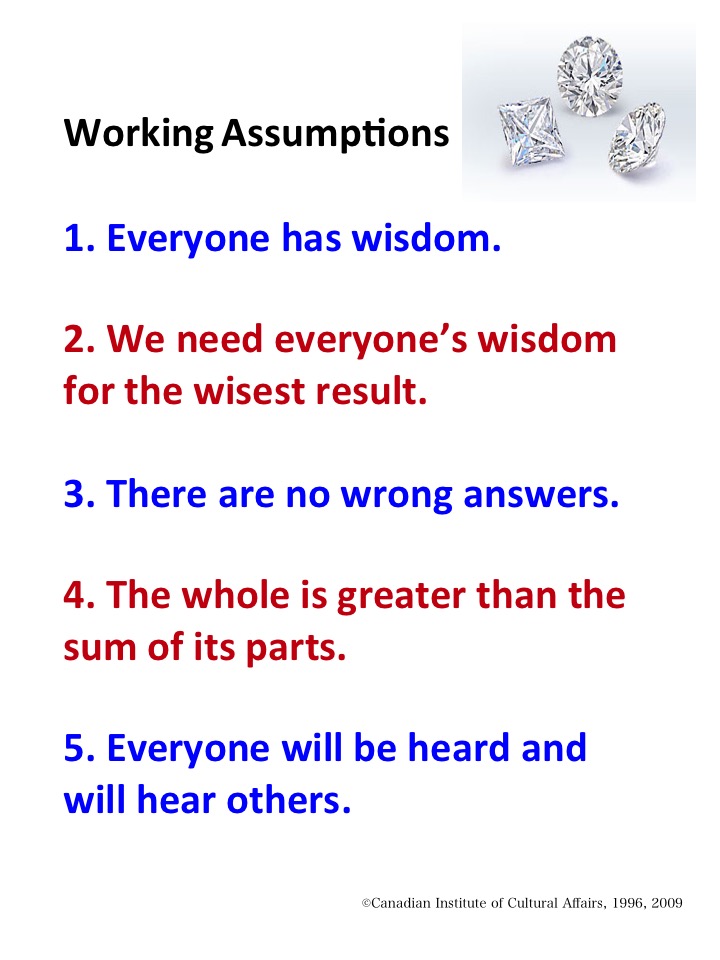
As individuals, we see one facet of the whole reality. When we are curious, ask open questions and listen to the answers from a wide variety of people who have a stake in the results, we gain a variety of grounded, realistic perspectives. If we don’t agree with the answers, asking questions that help someone articulate why they have come up with their answers helps us (as well as that person) to understand the bigger picture and make wiser decisions.
Really listening gains respect from those you are listening to. That respect allows creativity and teamwork to flourish. That in turn makes you and your team more productive.
The incorporation of more perspectives and life experience from a variety of people creates commitment and makes plans more effective.
And your increased productivity and effectiveness makes you more valuable, so that you are more likely to keep your job, get a promotion, or even get elected!
(And of course, given the topic of this post, I invite you to share your perspectives on this in the comments so that all of us can continue to learn from each other!)


